MONDO-DR Magazine Big Interview: Lou Mannarino, 1 SOUND
Mondo-dr
Big Interview: Lou Mannarino, 1 SOUND
by Daisy ThoroGood
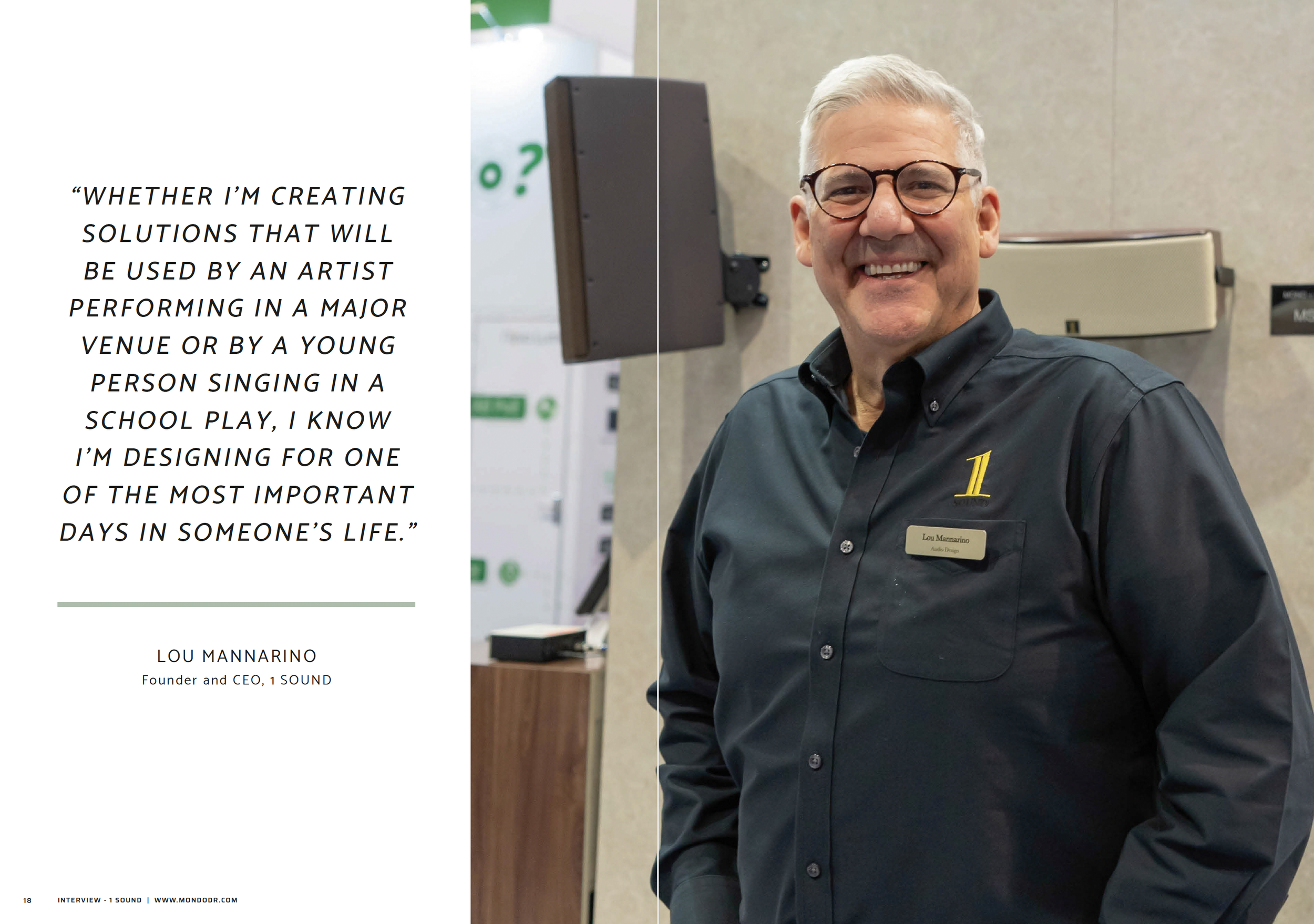
In a professional audio landscape sometimes defined by competition and rapid product cycles, Lou Mannarino, Founder and CEO of 1 SOUND, refuses to let market pressure or comparison fuel his work. The American manufacturer instead focuses on crafting audio systems it feels the field genuinely needs, because, as Mannarino puts it, “we’re in the service industry, after all.” 1 SOUND works on a principle of admiration for the audio and entertainment world, the CEO explained. “Without this industry, I would have never found my passion or been able to make a living. So, fundamentally, where 1 SOUND starts is with the utmost respect to all existing AV brands and to the pioneers behind them.” With this guiding philosophy and 40 years of experience in the music industry behind him, Mannarino began 1 SOUND in 2019, manufacturing its products in its home country, the USA. He again emphasised that these systems are proprietary to 1 SOUND and are built to fix the issues and fulfil the desires of audio professionals, with his motto being, “If I’m not solving a problem, then why try to create a resolution?”
Mannarino’s deep appreciation for sound technology can be traced back to the start of his over four-decade career in music, when he first picked up a bass guitar at age 11. “It was 1975, and I wanted to play in a band. However, nobody had PA systems yet! The industry was so fresh. Professional audio solutions were so new, that just a few years before, the Beatles played a stadium in New York using speakers that were meant for school hallways.” Driven by the mission to acquire a perfect sound system, Mannarino became immediately intrigued with making and owning solutions. “I started building. I would take the little money I earned from my after-school job, and I’d save to buy a microphone one week, a cable the next, a mixer soon after. By 1978, I’d accrued my first PA system.” This led to the young man setting up his production company the same year, which he is proud to claim was one of the first full-service production organisations in New York City. Mannarino’s father would drive him to his gigs, which began as high school plays and festival nights in churches. “I would take the money I earned from this work and invest it back into purchasing more audio equipment and understanding more about the technologies.” However, he noted, it was far from simple to learn the ins and outs of sound science. “There were no spaces, forums, or tradeshows to easily learn about the industry,” he said. “If I wanted to get to grips with a specific speaker, I would write a letter to the manufacturer and hope they replied to my question!”
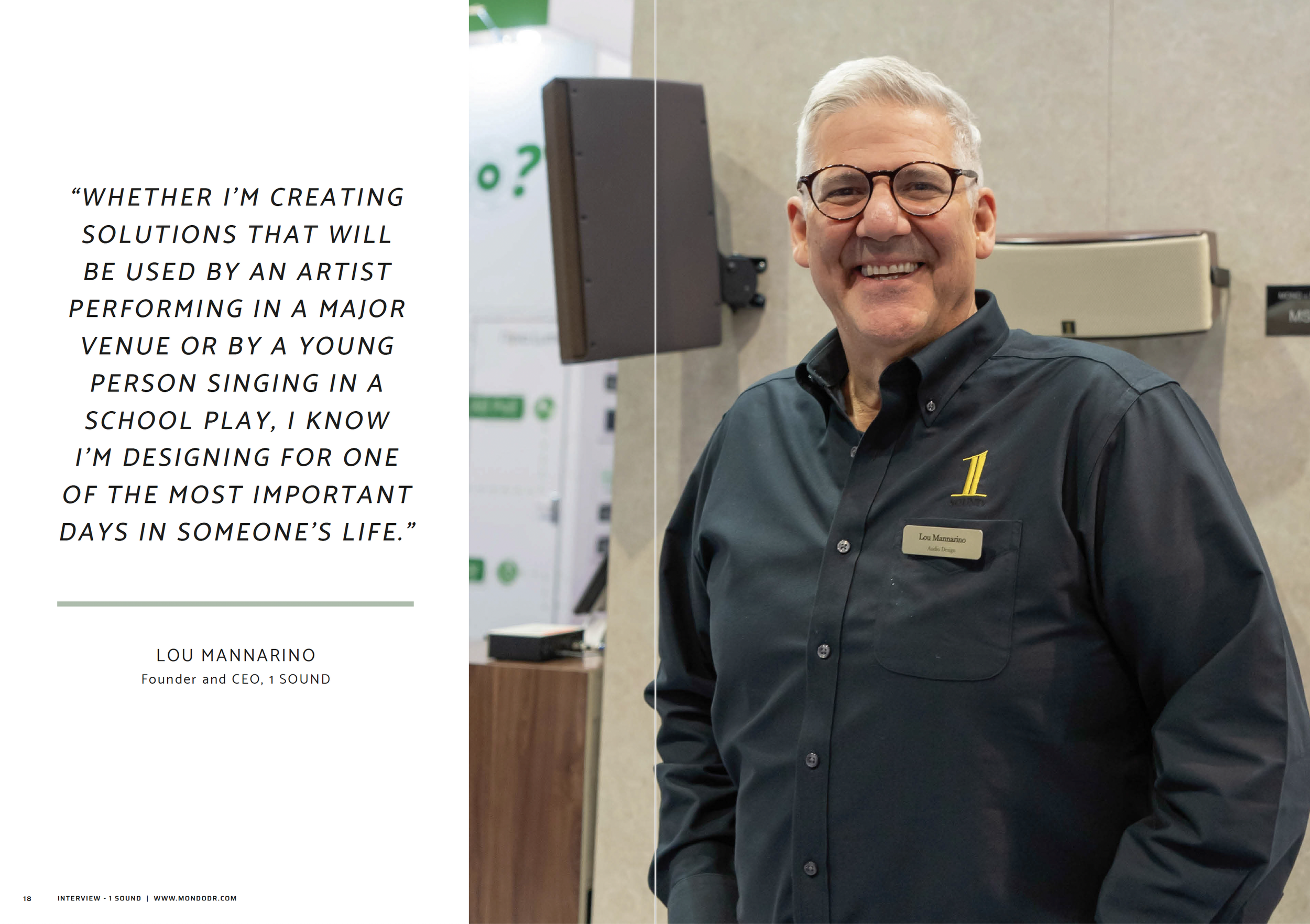
Despite this difficulty, Mannarino’s dedication to learning remained steadfast. He began to find unconventional methods of education. “I would get my father to drive me from Staten Island to Brooklyn, and leave me on the street in front of a music store. That’s because I knew that in the basement of that store, there was a repair person who was extremely knowledgeable about all things sound and PA. “So, day after day, I would sit outside and wait for him to walk out the door when his shift was finished. I’d beg him to teach me, and I’d ask a bunch of questions about the things I was seeing, like ‘how did the Grateful Dead get this sound at their recent gig?’, or ‘how does this loudspeaker work?’ I was an annoying kid, so obviously, he’d tell me to leave him alone!” “But one day, I offered to buy him lunch. He accepted and let me talk to him while he ate. From there, he started giving me all sorts of lessons; I learned soldering, building, and the art of audio. He taught me so much.” Mannarino’s craving for knowledge continued to bolster him through the years, as he earned himself a master’s degree in music and conducting, and a separate certification in music education. Working as a school conductor and a teacher earned him the money to sustain his production company, which saw him engineering the audio for major names such as Paul McCartney, Jay-Z, Bon Jovi, and the New York Pops orchestra. “Being a creative sadly costs a lot of money,” he stated. These performance experiences served to deepen his understanding of how sound systems must translate artistic intention. It was while designing for the New York Philharmonic that speaker manufacturer 1 SOUND began to blossom.
Mannarino needed a special multi-channel, roof-fill loudspeaker to sit on the lip of the stage – a technology he couldn’t locate anywhere. In response, he created the Panorama under the title 1 SOUND. The Panorama filled the technological gap the CEO needed to achieve the perfect audio for the Philharmonic; a passive loudspeaker featuring what he calls ‘Panorama Technology’, the system offers true stereo in its field. “I coined the moniker 1 SOUND as we were only supposed to create one sound, one speaker!” he laughed. Evidently, this was far from what would occur, as Mannarino started to work on the blueprints for other audio solutions he saw the industry was crying out for.
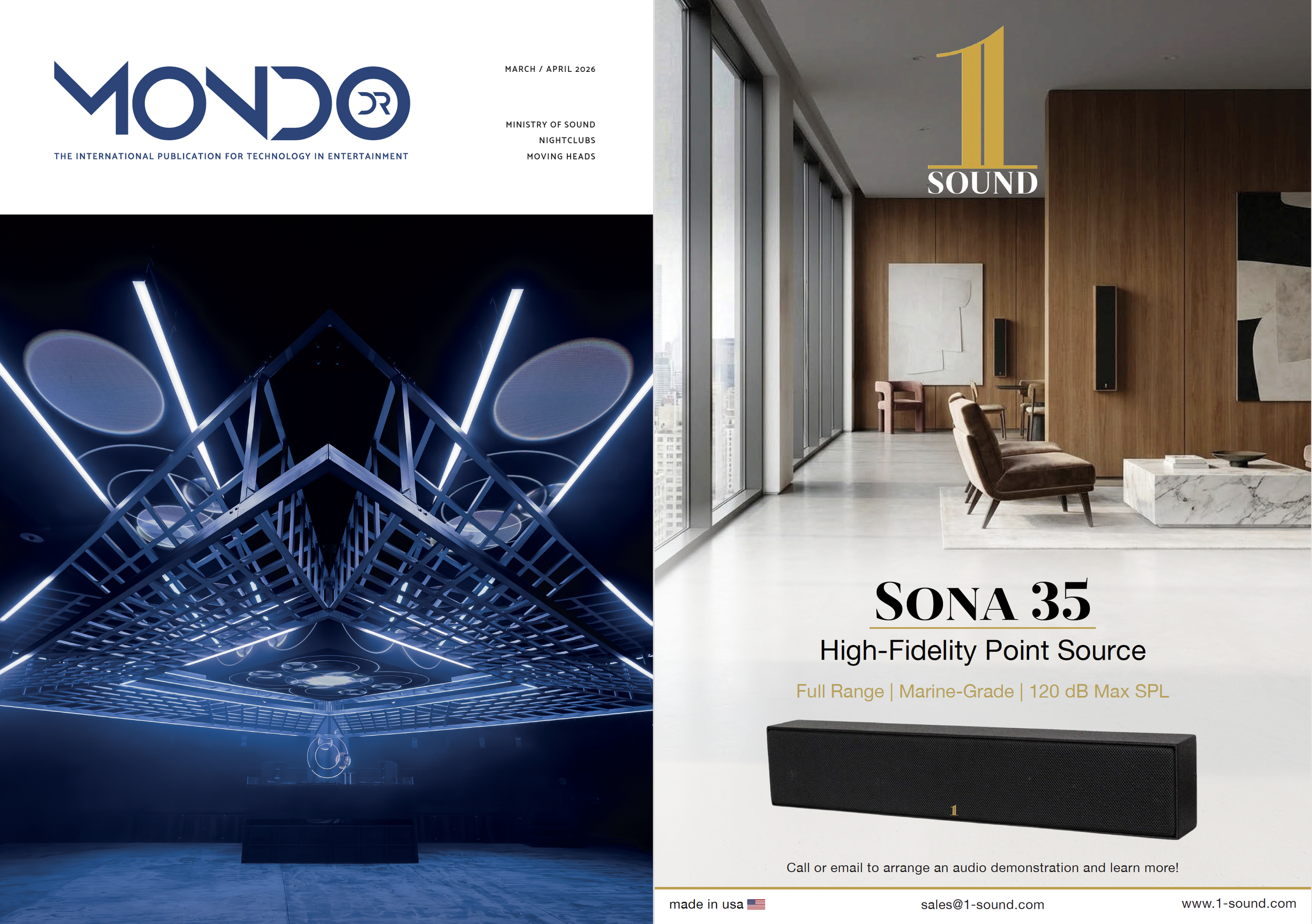
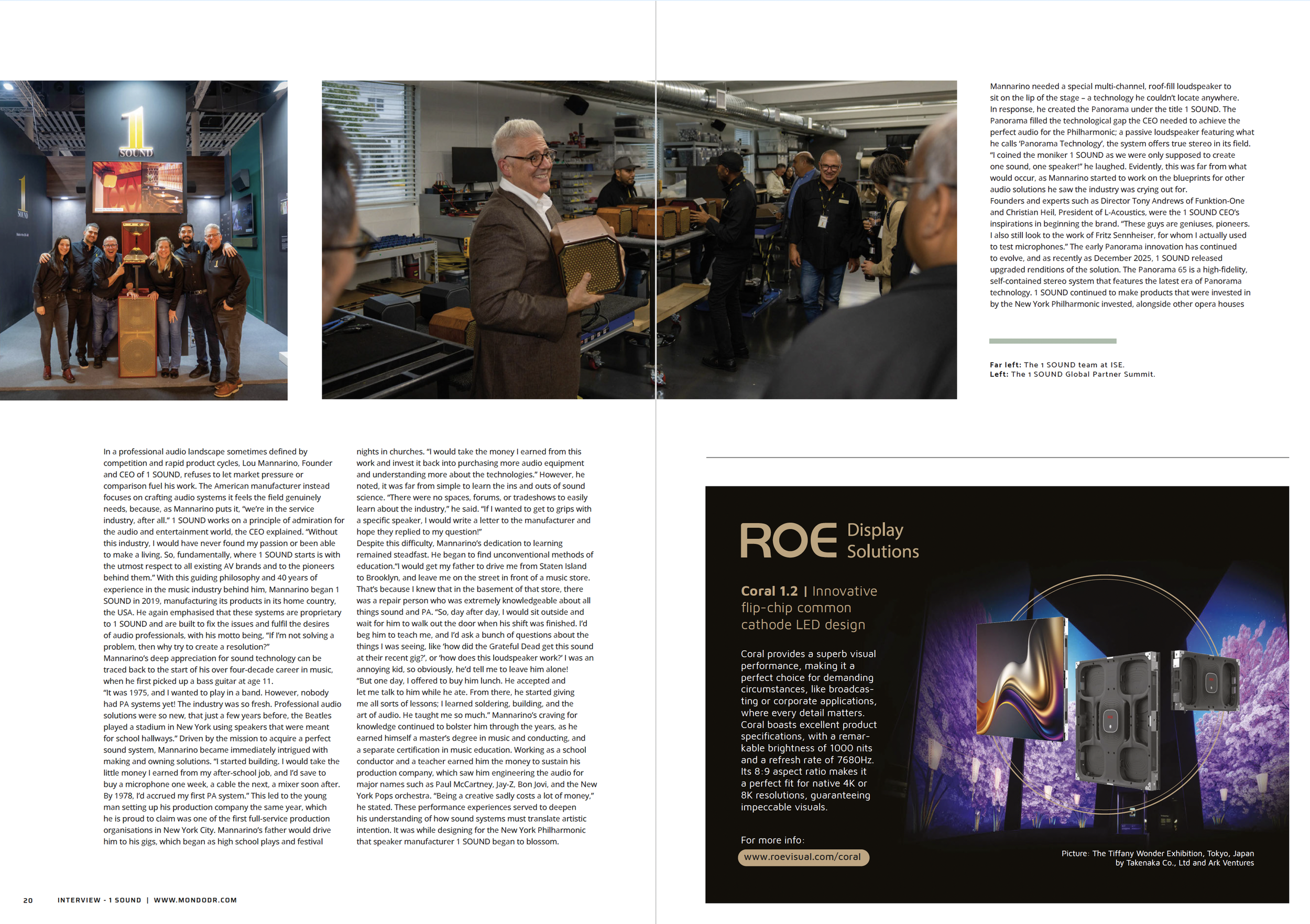
Founders and experts such as Director Tony Andrews of Funktion-One and Christian Heil, President of L-Acoustics, were the 1 SOUND CEO’s inspirations in beginning the brand. “These guys are geniuses, pioneers. I also still look to the work of Fritz Sennheiser, for whom I actually used to test microphones.” The early Panorama innovation has continued to evolve, and as recently as December 2025, 1 SOUND released upgraded renditions of the solution. The Panorama 65 is a high-fidelity, self-contained stereo system that features the latest era of Panorama technology. 1 SOUND continued to make products that were invested in by the New York Philharmonic invested, alongside other opera houses and museums across the globe, such as the MET Museum. The solutions began as tools for this large venue category, but they soon found wider relevance. As Mannarino refined methods for controlling dispersion and minimising acoustic spill, he discovered that the same technologies addressed pressing challenges in urban hospitality environments. “Quickly, we found out that there is a huge need for noise mitigation for rooftop clubs and bars,” he explained. “So, these products became popular for DJs and clubs, too.” Today, that cross-sector adoption defines the company’s footprint. 1 SOUND systems appear in theatres, museums, hospitality venues, retail environments, houses of worship, and entertainment spaces. Mannarino frames every 1 SOUND installation and creation, regardless of scale, as an opportunity to contribute to a meaningful experience.
“Building these sound systems, you get a chance to be a part of the most important day in someone’s life,” he said. “Whether I’m creating solutions that will be used by an artist performing in a major venue or by a young person singing in a school play, I know I’m designing for one of the most important days in someone’s life. I feel lucky to be a part of these moments.”
Asked what he sees as one of the most significant innovations of 1 SOUND, the CEO shared his pride at his company being an early adopter of active, fully cardioid control in its products. “The industry is slowly coming around to this technology now, but when we launched over six years ago, this design made our solutions uniquely musically coherent with high levels of control, and people could hear that.”
Systems such as 1 SOUND’s Level series are exemplary of such similar tech – a product line that Mannarino says he sees deployed regularly across various venue types.
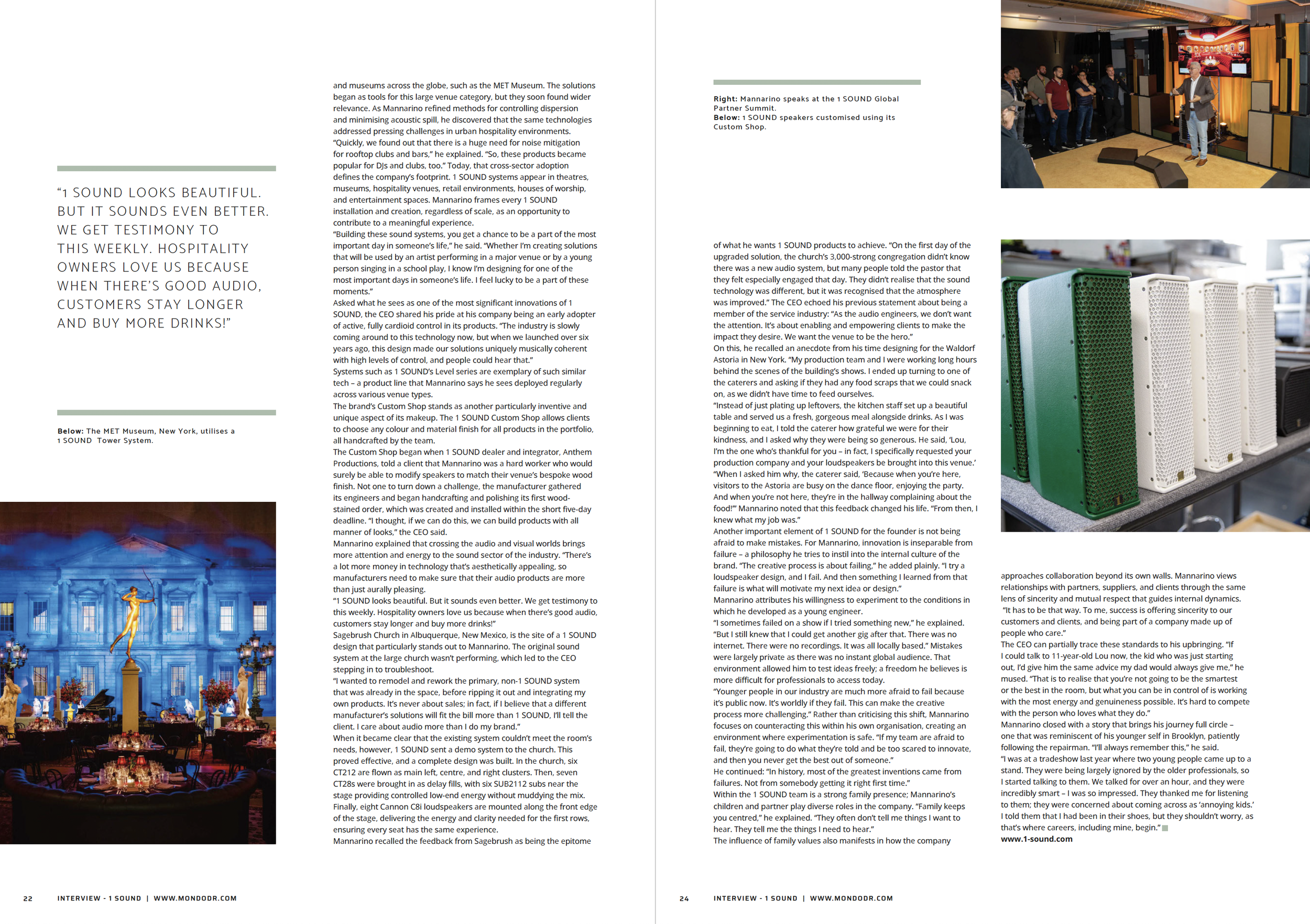
The brand’s Custom Shop stands as another particularly inventive and unique aspect of its makeup. The 1 SOUND Custom Shop allows clients to choose any colour and material finish for all products in the portfolio, all handcrafted by the team.
The Custom Shop began when 1 SOUND dealer and integrator, Anthem Productions, told a client that Mannarino was a hard worker who would surely be able to modify speakers to match their venue’s bespoke wood finish. Not one to turn down a challenge, the manufacturer gathered its engineers and began handcrafting and polishing its first woodstained order, which was created and installed within the short five-day deadline. “I thought, if we can do this, we can build products with all manner of looks,” the CEO said.
Mannarino explained that crossing the audio and visual worlds brings more attention and energy to the sound sector of the industry. “There’s a lot more money in technology that’s aesthetically appealing, so manufacturers need to make sure that their audio products are more than just aurally pleasing.
“1 SOUND looks beautiful. But it sounds even better. We get testimony to this weekly. Hospitality owners love us because when there’s good audio, customers stay longer and buy more drinks!”
Sagebrush Church in Albuquerque, New Mexico, is the site of a 1 SOUND design that particularly stands out to Mannarino. The original sound system at the large church wasn’t performing, which led to the CEO stepping in to troubleshoot.
“I wanted to remodel and rework the primary, non-1 SOUND system that was already in the space, before ripping it out and integrating my own products. It’s never about sales; in fact, if I believe that a different manufacturer’s solutions will fit the bill more than 1 SOUND, I’ll tell the client. I care about audio more than I do my brand.”
When it became clear that the existing system couldn’t meet the room’s needs, however, 1 SOUND sent a demo system to the church. This proved effective, and a complete design was built. In the church, six CT212 are flown as main left, centre, and right clusters. Then, seven CT28s were brought in as delay fills, with six SUB2112 subs near the stage providing controlled low-end energy without muddying the mix. Finally, eight Cannon C8i loudspeakers are mounted along the front edge of the stage, delivering the energy and clarity needed for the first rows, ensuring every seat has the same experience.
Mannarino recalled the feedback from Sagebrush as being the epitome of what he wants 1 SOUND products to achieve. “On the first day of the upgraded solution, the church’s 3,000-strong congregation didn’t know there was a new audio system, but many people told the pastor that they felt especially engaged that day. They didn’t realise that the sound technology was different, but it was recognised that the atmosphere was improved.” The CEO echoed his previous statement about being a member of the service industry: “As the audio engineers, we don’t want the attention. It’s about enabling and empowering clients to make the impact they desire. We want the venue to be the hero.”
On this, he recalled an anecdote from his time designing for the Waldorf Astoria in New York. “My production team and I were working long hours behind the scenes of the building’s shows. I ended up turning to one of the caterers and asking if they had any food scraps that we could snack on, as we didn’t have time to feed ourselves.
“Instead of just plating up leftovers, the kitchen staff set up a beautiful table and served us a fresh, gorgeous meal alongside drinks. As I was beginning to eat, I told the caterer how grateful we were for their kindness, and I asked why they were being so generous. He said, ‘Lou, I’m the one who’s thankful for you – in fact, I specifically requested your production company and your loudspeakers be brought into this venue.’
“When I asked him why, the caterer said, ‘Because when you’re here, visitors to the Astoria are busy on the dance floor, enjoying the party. And when you’re not here, they’re in the hallway complaining about the food!’” Mannarino noted that this feedback changed his life. “From then, I knew what my job was.”
Another important element of 1 SOUND for the founder is not being afraid to make mistakes. For Mannarino, innovation is inseparable from failure – a philosophy he tries to instil into the internal culture of the brand. “The creative process is about failing,” he added plainly. “I try a loudspeaker design, and I fail. And then something I learned from that failure is what will motivate my next idea or design.”
Mannarino attributes his willingness to experiment to the conditions in which he developed as a young engineer.
“I sometimes failed on a show if I tried something new,” he explained. “But I still knew that I could get another gig after that. There was no internet. There were no recordings. It was all locally based.” Mistakes were largely private as there was no instant global audience. That environment allowed him to test ideas freely; a freedom he believes is more difficult for professionals to access today.
“Younger people in our industry are much more afraid to fail because it’s public now. It’s worldly if they fail. This can make the creative process more challenging.” Rather than criticising this shift, Mannarino focuses on counteracting this within his own organisation, creating an environment where experimentation is safe. “If my team are afraid to fail, they’re going to do what they’re told and be too scared to innovate, and then you never get the best out of someone.”
He continued: “In history, most of the greatest inventions came from failures. Not from somebody getting it right first time.”
Within the 1 SOUND team is a strong family presence; Mannarino’s children and partner play diverse roles in the company. “Family keeps you centred,” he explained. “They often don’t tell me things I want to hear. They tell me the things I need to hear.”
The influence of family values also manifests in how the company approaches collaboration beyond its own walls. Mannarino views relationships with partners, suppliers, and clients through the same lens of sincerity and mutual respect that guides internal dynamics. “It has to be that way. To me, success is offering sincerity to our customers and clients, and being part of a company made up of people who care.”
The CEO can partially trace these standards to his upbringing. “If I could talk to 11-year-old Lou now, the kid who was just starting out, I’d give him the same advice my dad would always give me,” he mused. “That is to realise that you’re not going to be the smartest or the best in the room, but what you can be in control of is working with the most energy and genuineness possible. It’s hard to compete with the person who loves what they do.”
Mannarino closed with a story that brings his journey full circle – one that was reminiscent of his younger self in Brooklyn, patiently following the repairman. “I’ll always remember this,” he said.
“I was at a tradeshow last year where two young people came up to a stand. They were being largely ignored by the older professionals, so I started talking to them. We talked for over an hour, and they were incredibly smart – I was so impressed. They thanked me for listening to them; they were concerned about coming across as ‘annoying kids.’ I told them that I had been in their shoes, but they shouldn’t worry, as that’s where careers, including mine, begin.”